
“Maybe the spirit of John Peel has sunk through to people like me and the next generation. The one thing that I think people do need is a little bit of direction and to believe in certain people.”
– Gilles Peterson 2015

Gilles Peterson is a broadcaster, DJ and record collector who’s played a pivotal role in supporting forward-thinking underground music in the UK and beyond over the past three decades. He hosts weekly primetime Saturday afternoon show on BBC Radio 6 Music that’s one of the broadcaster’s most popular music shows, helms independent record label Brownswood Recordings, and is the founder of online radio station Worldwide FM.
Throughout his career, Peterson has promoted the new frontiers of jazz, hip-hop, and electronic music. He’s been recognised for his work with an MBE in 2004, an AIM Award for Indie Champion 2013, the Mixmag Award for Outstanding Contribution To Dance Music in 2013, the PRS for Music Award for Outstanding Contribution to Music Radio in 2014, and The A&R Award from The Music Producers Guild in 2019.
Gilles Peterson – 1st Ever Essential Mix BBC Radio 1 2006 with Pete Tong
Starting his career installing illicit transmitters and hosting shows for pirate radio station Radio Invicta, he later joined the newly-founded Jazz FM and, after that, joined the influential pirate-turned-legal station Kiss FM. In 1998, he was hired by BBC Radio 1, where he hosted a weekly show until his move to his current slot on BBC Radio 6 Music. He also hosts a syndicated radio program that is broadcast all over the globe, from London, to New York, Mexico City to Paris.
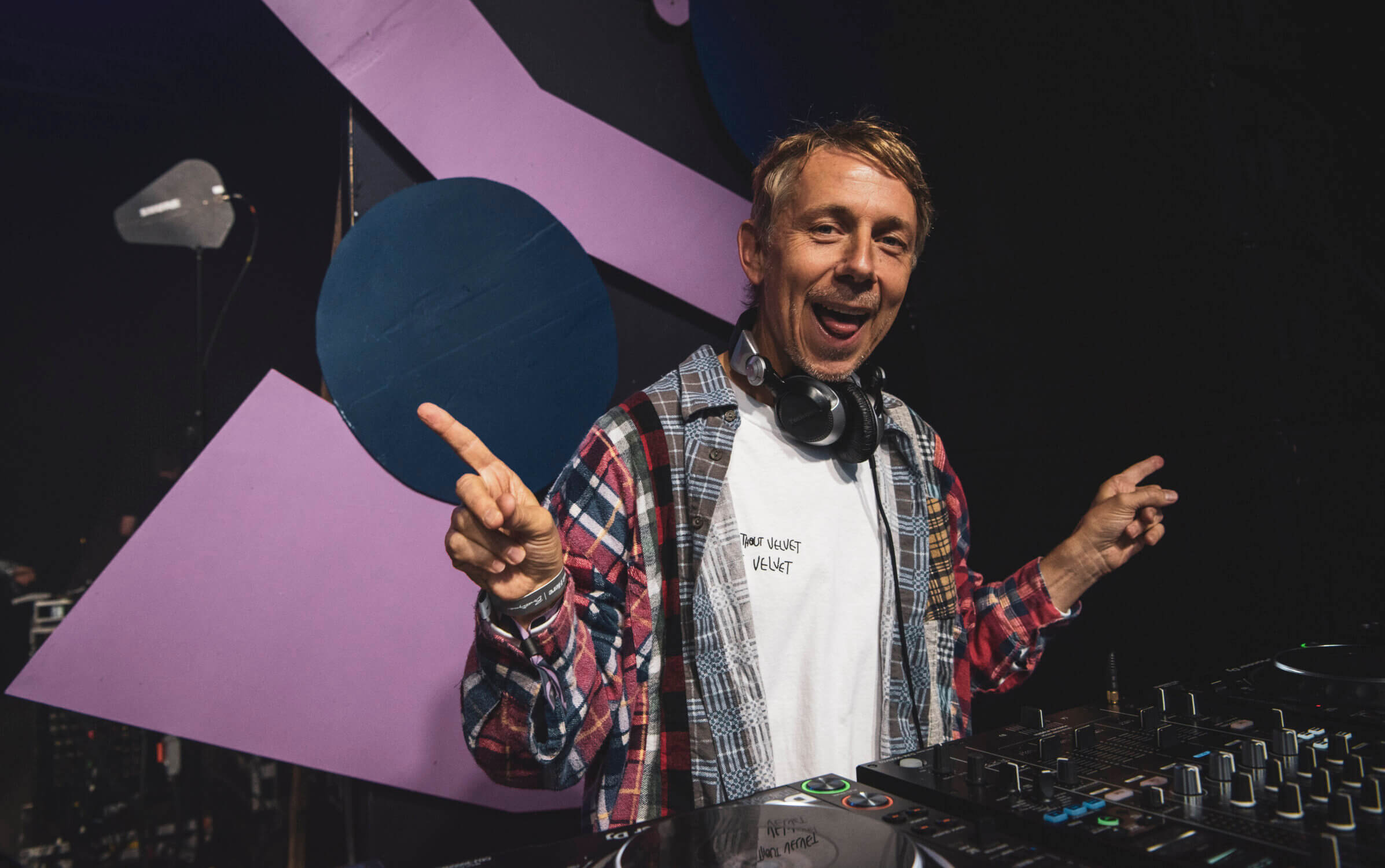
Gilles Peterson @ We Are Out Here
He has been behind several game-changing record labels. Firstly, he founded Acid Jazz in the late eighties, and later he started Talkin’ Loud, whose roster included Incognito, Galliano, Young Disciples, Courtney Pine, MJ Cole, Terry Callier, The Roots, 4 Hero, Nuyorican Soul, Carl Craig’s Innerzone Orchestra and Roni Size’s Reprazent project. Five of the albums on Talkin Loud were nominated for a Mercury Prize, with Reprazent’s New Forms winning in 1997. His current venture, Brownswood Recordings, was formed in 2006 and has released Ghostpoet’s Mercury Prize-nominated debut album and the 2018 We Out Here project, a celebrated compilation showcasing the UK’s thriving young jazz scene. As a curator and collector, he’s compiled over 100 albums.

In 2011, he founded the Steve Reid Foundation in memory of the legendary jazz drummer. The charity supports musicians who are ill and facing financial difficulties, with past recipients of support including Arthur Blythe, Bernie Worrell and George Cables. They’ve also partnered with the PRS for Music Foundation to create the Steve Reid InNOVAtion Award, which has supported upcoming artists such as Moses Boyd, Nubya Garcia and Sarathy Korwar. He curated the Look Up event series in 2018, which explored the arts and mental health and raised £20,000 for youth mental health charity Safaplace.
He is behind several events championing the music that he supports through his DJ sets and radio shows. Since 2005, he has hosted the annual Worldwide Awards in London and Worldwide Festival in Sète, France, and since 2015, a winter ski edition of the latter in Leysin, Switzerland. Gilles set up the online radio station, Worldwide FM, in 2016 and in 2019 he is launching the new We Out Here festival in the UK.
[Rewind 2015]

DJ, record label-owner, festival curator, radio presenter and all-round music guide, we chat to the man that is Gilles Peterson about artist selection, returning to UK festivals and going global in his search for the perfect beat.
Hi Gilles, how are you doing?
Very well, cheers!
You play internationally, so what does it mean to you to come back and do UK sets like Tramlines Festival?
It’s a lot less travelling, better paid and it’s easier! I don’t know why I ever go to Heathrow! It’s good to do stuff in the UK. I’m a renowned Londoner because I’ve been DJing on pirate radio, but I’m one of the Londoner’s that’s probably done the most outside of London from back in the ‘80s and I’ve always thought it was good to spread the word about the music. For me, it’s always a pleasure.
Your name for many people is synonymous with quality selection; has that been the foundation for your label, Brownswood?
The label’s an interesting one because everything that I do is somehow connected but the label doesn’t have a philosophy as such as much as the previous labels might have had, where you might have expected a certain sound. With us here, it’s been quite random, on one hand we release solo piano stuff and on the other hand we release pop electronic music. It’s quite diverse. I try and find an ideology for the label but I don’t quite know what it is!
Hearing the albums, it almost sounds like each of the Bubblers is a project. You’ve got some things from Jose James and Flying Lotus…
The Bubblers albums is an example of the stuff that I would champion on the radio and doesn’t really have an outlet. It’s funny actually because that was the first money Flying Lotus had ever received, and I remember going to see him in a shady back street in Shoreditch with £200 in an envelope and giving him the cash to let us have that track on the album! It’s weird to think back to those days when someone like Flying Lotus wasn’t getting exposure – before Brainfeeder – and the label and compilations have always been little nuggets that I’d be playing on the radio that would come out of nowhere. That’s where the Bubblers thing came from and it’s been a good representation of the sound of Brownswood Records.
What’s your process of artist selection for festivals?
It’ just fun, isn’t it? It’s the best thing about combining radio, producing artists, A&R and club nights. Even when I was running clubs like Talkin’ Loud at Dingwalls or Monday nights at the Wag Club, I always incorporated live music with DJ culture and that was quite out of the norm back then. Then I spent time working at the Montreux Jazz Festival in Switzerland where I spent 10 years curating, and after that I decided to start my own festival, and that was just the perfect excuse to pick my favourite artists of that year ranging from obscure African music to out-and-out contemporary British bass culture. For me, that’s loads of fun. For the moment I’m putting together the final touches for the Worldwide Festival 10th Anniversary, and I’ve got two or three final nuggets to place. I’m trying to get a piano player called Ed Motta to perform and that will be the final piece of the puzzle. Someone always pops up in the last month before the festival, so you’ve always got to leave a little bit of money spare for that!

We’ve been to Traction Festival, Worldwide Awards and Set; have you got any other exciting projects lined up?
What I’m doing as a curator is pretty much limited to the festival and annual Worldwide Awards, but I’m going back to Cuba next week to do a new record about the depths of rhumba. I’m doing a bunch of compilations; a new Sun Ra album, and an album on a label called MPS – a Jazz label, which was probably the best Jazz label in the ‘60s and ‘70s. I’m doing a lot of radio stuff with the BBC, so I did a big thing yesterday with Chassol, I’m doing an interview today with Jamie XX – so very busy!
With people consuming music so rapidly, in a disposable way, does the term “tastemaker” still apply to upcoming radio DJs?
I don’t know! It’s odd… We have the most famous tastemakers in the UK, it’s like Zane Lowe working for Apple now – they’re coming here because American radio is so regionalised whereas we have a celebration of the BBC and that all goes back to John Peel, he was the one person that worked out of the box and was prepared to put his neck on the block and believe in music. I feel very blessed that I was able to spend some time with him. Maybe the spirit of John Peel has sunk through to people like me and the next generation. The one thing that I think people do need is a little bit of direction and to believe in certain people. It’s like, I like film, and I swear by Mark Kermode, he’s my guide because he’s an expert.
Do you feel like the record culture livens the scene compared to the flash-in-the-pan digital culture?
Definitely, and that’s the reaction to it. People like Floating Points and Caribou and Jamie XX, they’ve all inspired a new generation to think that way. Whether it’s the jazz dance scene to the northern soul scene and the modern soul scene, there’s always been little fragments of scenes that have created a new underground, and it’s really important that DJs and producers of these guys are reminding people of that history, so you can go and listen to Floating Points and they’ll hit you with crazy, weird records. It’s a complete antithesis to the Ibiza culture and I think that’s brilliant. I go to some places around the country and the audience are really but they don’t wanna hear 4 4! The relationship that they have with music is really interesting because they like dance music and the environment of club culture, but if anything sounds a little too close to the wrong sort of beat, they switch off.
Your search for the perfect beat has led you to Africa, Brazil and Cuba; where next? Do you see yourself doing something in Japan?
Yeah, I’d love to do loads of them! The rhumba album is like the ultimate conclusion of that search, because rhumba is the source of everything. It’s the connection between the slave ships of Africa bringing the music and this mystery of communication and rhythm through music. If you look at rhumba and how much music it’s influenced ie the original percussionists, congo players going to New York and changing the face of Jazz music, Tito Puente coming to New York in the ‘50s and changing the music scene with Latin big bands and cha cha cha, which culminates with really bad dance on Strictly Come Dancing! For me to go and find out the inner workings, that is the root of dance music and probably where the perfect beat exists.
Keeping in mind that quality is number one for you – how many records are in your collection?
I don’t count them! I’ve got quite a lot and I’m constantly buying, that’s the problem. I’m probably at 30-40,000, but I do get rid of shit that I don’t like anymore!
Gilles plays at Tramlines Festival in Sheffield on Saturday 25 July 2015.
Tickets cost £30 + bf from www.tramlines.org.uk